


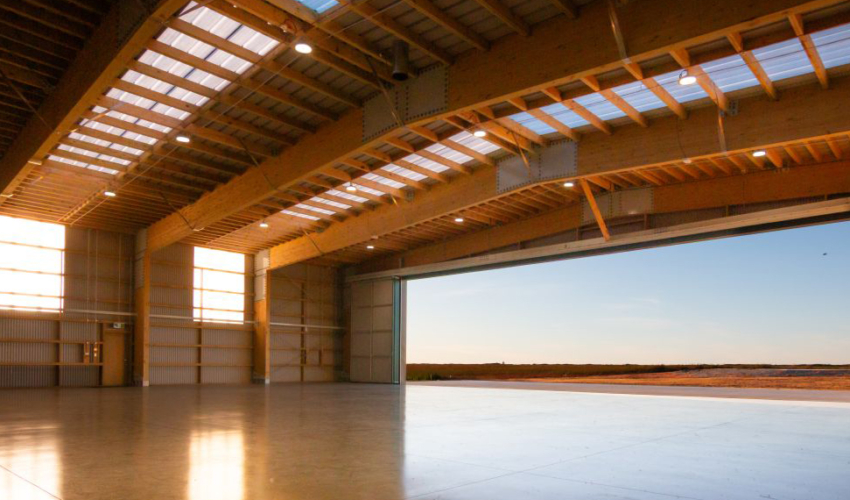
With New Zealand’s government setting an ambitious goal to double the combined space and advanced aviation sectors – currently valued at near $3 billion – by 2030, the recently opened Tāwhaki National Aerospace Centre near Christchurch has solidified Aotearoa’s position in the global aerospace industry. The Centre is in position to become a vital link connecting regulatory bodies, innovators and key industry stakeholders while fostering a safe and sustainable aerospace ecosystem. Techlam played a pivotal role in delivering the Centre’s state-of-the-art aircraft hangar – an essential component of the new infrastructure designed to propel New Zealand’s future aerospace endeavours.
Techlam collaborated closely with Tuatara Structures, PTL Structural & Fire and other key partners during the hangar’s construction. Techlam’s contribution centered on providing prefabricated glulam portal frames and bespoke hardware for the 600m² facility. The CNC-machined portal beams – 15 metres each – create an expansive 30-metre clearspan interior that provides unobstructed space for aircraft storage and operational activities.
The selection of glulam timber for the hangar structure was a deliberate choice, driven by its inherent advantages in performance, aesthetics and sustainability. Jordan Frizzell, Founder and Managing Director of Tuatara Structures, highlighted these considerations: “Glulam was selected for its superior environmental performance, aesthetic appeal and structural adaptability. It provided a warm, natural finish suitable for a high-profile aviation facility and aligned with the project’s sustainability objectives.”
The decision to utilise engineered timber was further influenced by the site’s environmental zoning and a clear desire to showcase sustainable building technology. Techlam glulam’s capacity for long spans proved particularly advantageous in meeting the hangar’s need for unobstructed internal space. “Structurally, glulam performed comparably to steel in terms of load-bearing capacity,” Frizzell said. He also noted glulam’s predictable charring rates in fire, making it a competitive choice for the hangar’s structural framework.
Beyond its structural integrity, glulam’s environmental credentials were a primary driver. The use of glulam resulted in a substantial reduction in embodied carbon. “Using glulam led to an estimated embodied carbon reduction of up to 80% compared to a steel structure,” Frizzell explained. “Timber also sequesters carbon, further enhancing its environmental profile.” This aligns with global movements towards low-carbon construction, positioning the Tāwhaki National Aerospace Centre’s aircraft hangar as a model for sustainable infrastructure within the aerospace sector.
Efficiency in construction was also a significant benefit realised through the prefabrication capabilities employed by Techlam. “Components arrived pre-cut, pre-finished, and ready for assembly. This reduced waste and ensured tight tolerances,” Frizzell detailed. This precision manufacturing streamlines on-site assembly, contributing to project quality and programme adherence.
The project has drawn positive feedback from across the industry. “Feedback has been overwhelmingly positive. Clients appreciated the sustainable credentials, while engineers highlighted the successful integration of structure and architecture. Contractors praised the streamlined on-site process,” Frizzell reported. Reflecting on the broader implications, Frizzell strongly advocates for the continued application of engineered timber: “Engineered timber is highly recommended for large-span applications, particularly where aesthetics and sustainability are priorities. It’s a viable, competitive alternative to steel when managed appropriately.”
The Tāwhaki National Aerospace Centre’s aircraft hangar project is a great example of what makes glulam such an attractive building material: it matches steel’s structural performance while delivering significant environmental benefits, it offers design flexibility for large spans, and it provides the warm and natural aesthetics that many projects now require.
As the construction industry increasingly prioritises sustainability alongside performance, glulam’s combination of low embodied carbon, carbon sequestration and manufacturing efficiency make it the ideal material that can meet both current needs and future environmental goals.
Read our Case Study here.