


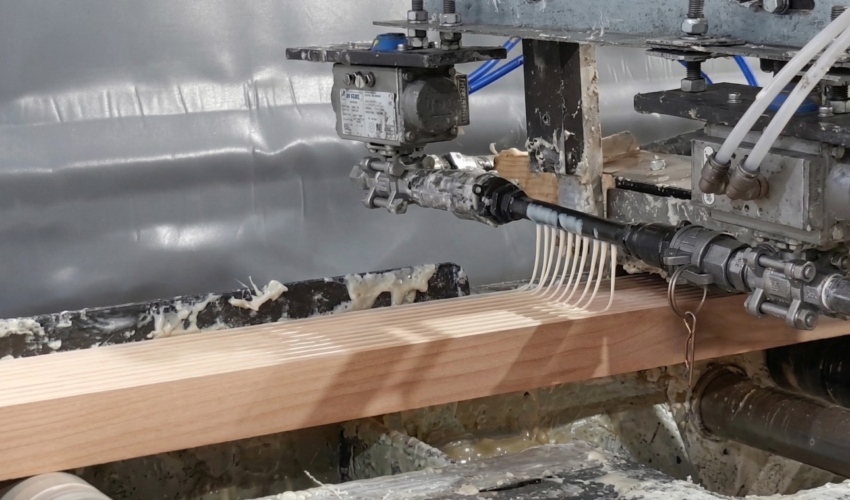
Techlam made the active decision to use only one-component polyurethane adhesive (1K PUR or 1C PUR) in the manufacture of all Techlam glulam products, irrespective of wood species and use (interior and exterior).
PUR is formaldehyde free, so low VoC. The glueline is clear so the aesthetic of the Techlam glulam member remains intact.
Techlam’s decision has been made after careful assessment of:
- adhesive performance (bond strength and stability over the intended life of the product)
- timber characteristics (e.g. pH and softness)
- the installation requirements to ensure building code compliance and performance.
Our research
1KPUR is a strong, ready-to-use glue. No mixing required.
Curing is the name given to the chemical reactions that result in a three-dimensional, crosslinked polyurethane/urea polymer network which bonds the lamina. This begins when 1KPUR is exposed to moisture in the air or in the materials being bonded.
The process of curing is as follows:
- Initially, the surface skins over.
- Then, as the chemical reaction continues flexible bonds are formed and carbon dioxide (CO2) is released. A small amount of foaming is normal and helps to fill small gaps. Too much foaming can cause problems such as weaker bonding. This can occur if there is a lot of moisture, the adhesive layer is spread too thickly, or bonding conditions are very warm and humid.
- Finally, the adhesive changes from a liquid into the three-dimensional crosslinked polyurethane/urea polymer network.
It is this network that provides:
- high bond strength
- excellent heat resistance
- good environmental durability
- permanent, thermoset characteristics.
The speed of curing process is influenced by:
- ambient humidity
- temperature
- substrate porosity (porous materials accelerate cure)
- adhesive thickness.
1KPUR & NZ buildings
Service Class 3 performance
Service class 3 covers all exterior conditions – any timber EMC, any temperature – and requires the use of a Type 1 adhesive. 1KPUR is a type I adhesive.
It is sometimes inferred that resorcinol (another type I adhesive) is superior to PUR. A comparison of PUR and Resorcinol adhesives was undertaken1. It was found that there was no difference in performance between PUR and Resorcinol.
Performance in conditions more onerous than service class 3
Irrespective of the adhesive used, AS/NZS1328:1998 & Service Class 3 does not cover in-ground conditions where other factors may apply.
This means proof of performance (durability) for glulam needs to rely on other methods such as:
- predictions based on the chemistry of the adhesive
- testing that replicates the in-ground conditions whether through accelerated testing or through time-based in-situ studies
- historic evidence of systemic failure
- installation requirements that may create environmental conditions closer to H3.2.
Despite extensive research and industry discussions, Techlam has not been able to find any evidence of:
- published NZ based in-ground testing of glulam irrespective of adhesive type, or
- historic evidence of systemic failure relating to the in-ground use of glulam irrespective of adhesive type.
1K PUR Chemistry in glulam
Research has considered the performance of glulam in conditions more onerous than those tested for in AS/NZS 1328.1:1998. These conditions include higher saturation point (30%), longer exposure times, greater temperature4 and humidity fluctuations, the manufacturing process, and the timber itself.
What has been concluded is that:
- the causes of failure of the glue line and the glulam member are complex, and at times, irrelevant of the adhesive used and
- PUR adhesives demonstrate stable bond performance under normal service conditions. Available research indicates that any reduction in bond strength for
- PUR adhesives occurs only with prolonged exposure to extreme environments, such as sustained temperatures around 60°C combined with relative humidity in the 95–100% range.
Installation Requirements
NZS3640 prescribes chemical treatment necessary to prevent biological decay for different hazard classes. Other environmental factors that result in changes to the material are not considered.
Timber is hygroscopic. It will be subject to expansion and contraction; therefore, it is good building practice that timber buried in the ground should be coated with a moisture resistant coating.
Techlam’s installation requirements are a direct response to their understanding of the hygroscopic nature of timber, as well as preventing the of exposure to prolonged conditions of 60⁰C and RH 95-100%.
Techlam’s installation requirements
Techlam’s philosophy is that irrespective of the hazard class, exterior use should be designed and installed to minimize the risk of a prolonged elevation of the EMC. To this end Techlam strongly recommends:
- that the design facilitates the shedding of water by avoiding or protecting horizontal surfaces where water can pool
- sealing end-grains to avoid water uptake
- ensuring that unsealed glulam is at least 150 mm above un-paved surfaces to reduce the risk of wicking
- coating with a long-term water repellent coating to enhance the long-term appearance of glulam members.
Where Techlam glulam members are to be installed in-ground then there are additional mandatory requirements.
- Techlam H5 posts are to be used.
- The in-ground portion and up to the top of the concrete footing of the post is to be coated with a bitumen-based coating. Application is to be in accordance with the coating supplied.
- The top of the concrete footing is to slope away from the post.
For further building code compliance information refer to Techlam’s Glulam BPIR and Techlam H5 Basis of Compliance.